
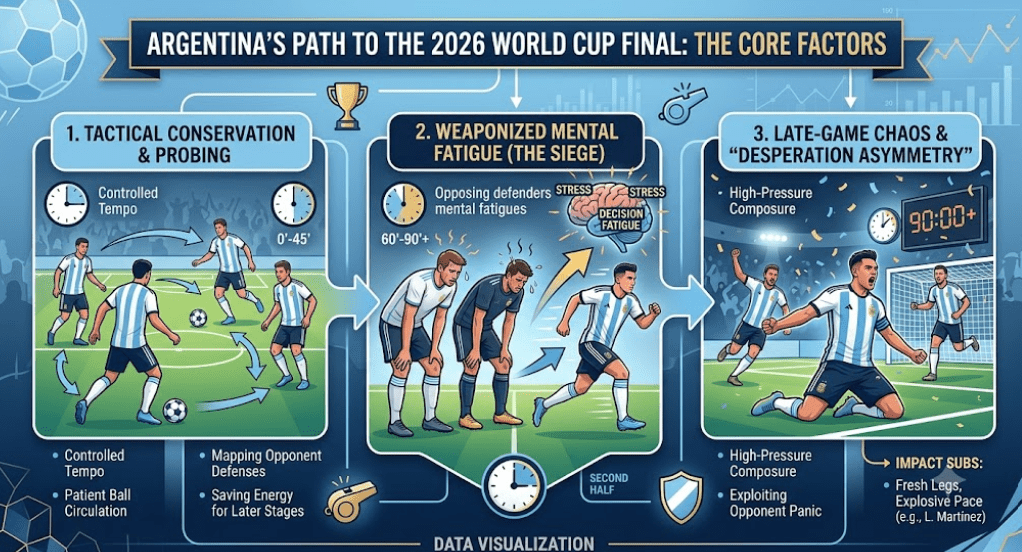
We’ve all watched a match where one side seems completely outmatched for the first hour, only to morph into an unstoppable juggernaut in the final fifteen minutes.
During the 2026 FIFA World Cup, Argentina turned this phenomenon into an absolute masterclass. We took a closer look at the main world cup related data below, which derives from https://fdp.fifa.org/ to analyse the smart tactics behind the football team’s success.
With 12 of their 19 tournament goals (63%) coming after the 75th minute, Argentina’s journey to the final wasn’t defined by early dominance, but by a ruthless tactical exploitation of late-game pressure.
But this wasn’t just luck. It is a highly repeatable formula rooted in cognitive science, physiology, and psychological momentum. While many football experts play the blame game, trying to explain why Argentina beat their opponents, we believe that their smart tactics outplayed them.
Whether you are an athlete, an entrepreneur, or a professional facing a high-stakes pitch, understanding how to conserve your energy and weaponize your opponent’s fatigue is the ultimate competitive advantage.The Science of the “Cognitive Siege”
To understand why Argentina’s strategy is so lethal, we have to look at what happens to the human brain under prolonged stress.
In sports science, we talk a lot about physical conditioning, but cognitive fatigue is often the real silent killer. A 90-minute soccer match requires non-stop executive functioning: reading passing lanes, tracking markers, and making split-second tactical decisions.
According to research on cognitive load theory in high-performance environments, as mental fatigue spikes:
- Reaction times decay exponentially.
- Visual search patterns narrow (players experience a form of “tunnel vision”).
- Decision-making degrades, leading to unforced, catastrophic errors.
By maintaining a patient, high-possession style early in the game (averaging a modest 54-56% possession in the first half-hour), Argentina forced their opponents to constantly slide, shift, and think.
They didn’t just exhaust their opponents’ legs; they exhausted their brains. When the 80th minute hit, and Argentina suddenly accelerated their attacking volume—skyrocketing to an average of 29 shots in the final interval—their opponents’ mentally depleted brains simply couldn’t keep up.
📅 Minute-by-Minute Late Goals Breakdown
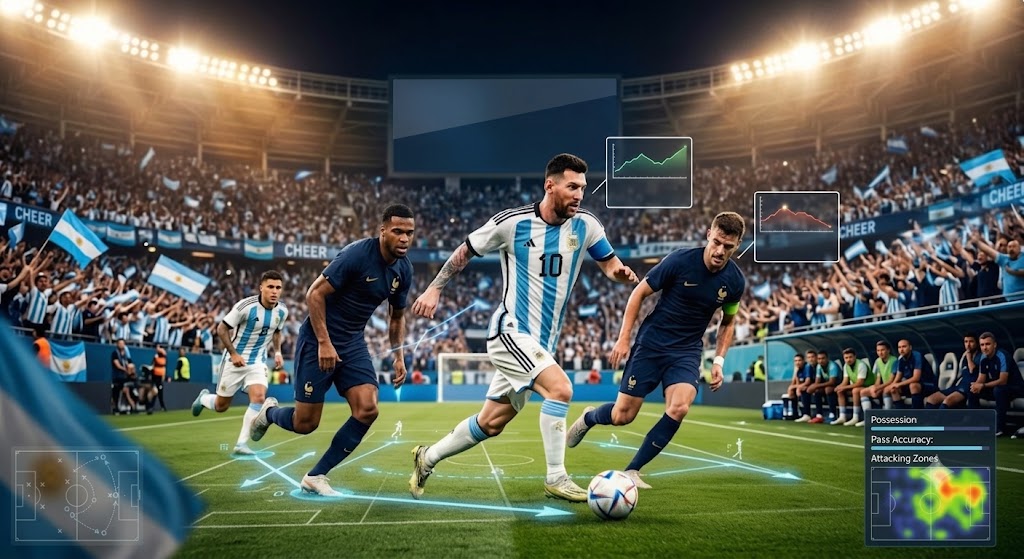
Argentina’s late-game pattern spans across both the group stage and their intense knockout run to the final:
| Match & Date | Late Goal Timings | Final Score | Impact / Key Moment |
| vs. Austria (June 22) | ⚽ 90+5′ (Messi) | 🇦🇷 2–0 🇦🇹 | Sealed the group stage victory with an insurance goal. |
| vs. Jordan (June 27) | ⚽ 80′ (Messi) | 🇦🇷 3–1 🇯🇴 | Free-kick clincher to secure the group finale. |
| vs. Cape Verde (July 3) | ⚽ 92′ (L. Martínez) ⚽ 111′ (Own Goal) |
🇦🇷 3–2 🇨🇻 | Rescued an extra-time thriller in the opening knockout round. |
| vs. Egypt (July 7) | ⚽ 79′ (Romero) ⚽ 83′ (Messi) ⚽ 90+2′ (Fernández) |
🇦🇷 3–2 🇪🇬 | Staged a 3-goal rally in the final 11 minutes to overcome a 2-0 deficit. |
| vs. Switzerland (July 11) | ⚽ 112′ (Álvarez) ⚽ 120+1′ (L. Martínez) |
🇦🇷 3–1 🇨🇭 | Broke a stubborn extra-time deadlock in the quarterfinals. |
| vs. England (July 15) | ⚽ 85′ (Fernández) ⚽ 90+2′ (L. Martínez) |
🇦🇷 2–1 🏴 | Overturned a 1-0 deficit with two Messi-assisted goals to reach the final. |
Psychological Momentum: The “Desperation Asymmetry”
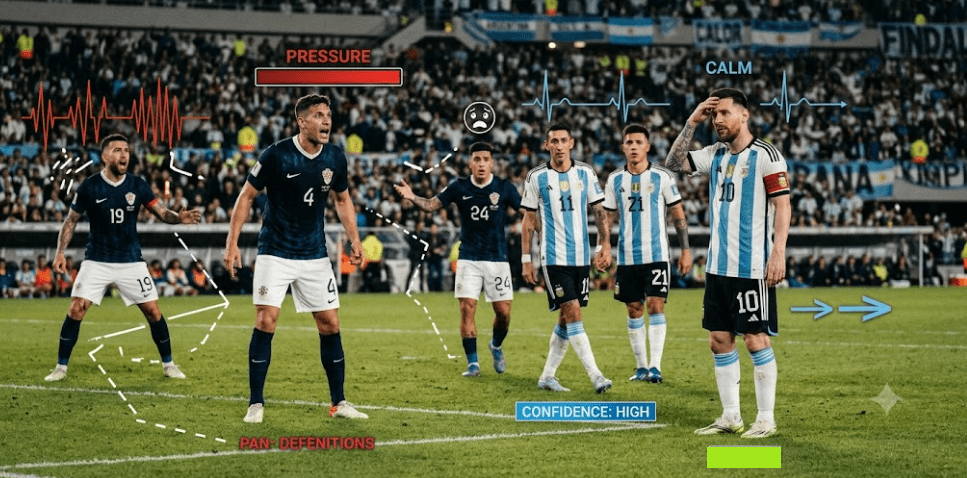
When a challenge reaches its climax, a psychological shift occurs. In sports psychology, this is known as Psychological Momentum (PM).
When a team is trying to protect a draw or a narrow lead late in a game, they instinctively shift from a proactive mindset to a reactive, survival mindset. They drop deeper, clear the ball aimlessly, and try to make the clock run out.
Argentina weaponized this asymmetry. Instead of panicking under late-game pressure, they stepped on the gas, keeping their composure and pushing their possession to a suffocating 65% to 67% in the final minutes and extra time.
Because they kept their technical clarity while their opponents panicked, they created a self-fulfilling prophecy: opponents expected Argentina to score late, grew anxious, made errors, and allowed Argentina to do exactly that.
📊 15-Minute Tactical Interval Metrics
| Match Interval | Avg. Possession % | Total Shots Attempted | Goals Scored | Tactical Profile / Phase |
| 1′ – 15′ | 56% | 11 | 1 | Probing & Setup: Slower tempo, mapping defensive structures. |
| 16′ – 30′ | 54% | 14 | 0 | Midfield Battle: Heavy pressing, low risk-taking. |
| 31′ – 45+’ | 58% | 16 | 2 | Late First-Half Press: Increasing urgency before the break. |
| 46′ – 60′ | 55% | 15 | 0 | Regrouping: Absorbing opponent adjustments post-intermission. |
| 61′ – 75′ | 60% | 21 | 4 | The Acceleration: Tactical substitutions introduce fresh pace. |
| 76′ – 90+’ | 65% | 29 | 7 | The Siege: Maximum pressure against flagging defensive lines. |
| Extra Time (ET) | 67% | 8 | 5 | Overtime Dominance: Total physical and mental control. |
Cross-Disciplinary Applications: Winning the Long Game
This “late-surge” framework isn’t exclusive to the soccer pitch.
The principles of conserving energy, absorbing early pressure, and unleashing a highly focused late assault apply to almost any competitive arena:
1. In Business and Negotiations
Many professionals burn all their intellectual stamina in the preparation phase or the opening minutes of a negotiation, leading to fatigue-induced concessions at the end.
- The Strategy: Use the “Probing Phase.” Let the other side present, defend, and exhaust their talking points early on. Listen actively, conserve your cognitive energy, and deliver your most persuasive, high-impact proposals in the final stages when their decision-making fatigue has set in.
2. In Academics and High-Stakes Exams
Students often panic and rush through the beginning of grueling multi-hour exams, only to hit a mental wall halfway through.
- The Strategy: Pace your cognitive load. Treat the first quarter of the exam as a steady “ball-retention” phase—building confidence with straightforward questions and pacing your energy. Save your peak focus and deep analytical reserves for the complex problem-solving sections at the end.
How to Utilise the Late Surge Tactic in Life: 3 Rules for Personal Betterment
If you want to adopt Argentina’s championship blueprint for your own challenges, you must train for it.
Here is how to build a “late-surge” toolkit:
1. Build Cognitive Stamina (Mental Conditioning)
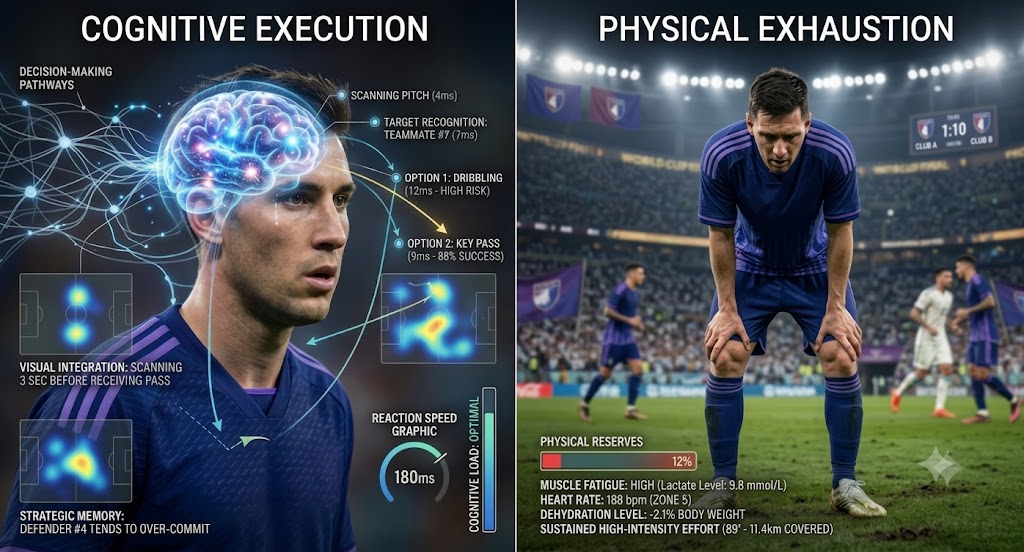
You cannot survive a late-stage siege if your brain is prone to quitting early. Train your mind to operate under fatigue.
- Actionable Tip: If you are studying or working on a complex project, practice “over-distance” mental sessions. Intentionally schedule your most cognitively demanding task at the very end of your workday once or twice a week. Train your brain to find clarity when it wants to shut down.
2. Master Emotional Regulation Under Pressure
When the clock is ticking down, anxiety spikes cortisol, which destroys fine motor skills and rational thinking.
- Actionable Tip: Implement “tactical breathing” (box breathing) during high-stress moments. This down-regulates your nervous system, preventing the panic-induced low-block mindset that leads to failure, and keeps you in a proactive state of flow.
3. Know When to Unleash Your “Super Subs”
Argentina’s late-game success was heavily aided by introducing explosive, fresh substitutes against exhausted defenders. In life, your “subs” are your external tools, routines, or pre-planned pivots.
- Actionable Tip: Always have a “Plan B” or a secondary burst of resources ready to deploy at the 80% mark of a project. Whether that is a pre-drafted closing pitch, a fresh wave of team support, or a structured break strategy, save a distinct resource to inject energy right when the finish line is in sight.
Tactics for Success in Sports and Life
Argentina’s 2026 World Cup run proved that winning isn’t about being the loudest or fastest out of the gate. It is about physiology and psychology, endurance, emotional discipline, and knowing exactly when to strike. By pacing your energy, embracing the late-game pressure, and letting your competition exhaust themselves, you can turn the final minutes of any challenge into your personal victory lap.
Author Profile

- Manuela is often busy typing away, but she also loves embracing the digital nomad lifestyle, exploring her favorite city, London, and traveling to experience new cultures and countries.
Latest entries
 being-healthyAugust 19, 2026How to Create Healthy Technology Habits for Better Digital Wellbeing
 being-smartJuly 21, 2026Smart Budgeting: Apply the 50/30/20 Rule to Improve your Life
 being-smartJuly 17, 2026The Smart Football Tactics of the Late Surge: How Argentina Reached The World Cup Final 2026
 being-creativeMay 21, 2026Best Magazine Ideas for Startups: What Every Founder Should Be Reading in 2026