
Managing your personal finances doesn’t have to feel like a high-stress chore and can improve your life dramatically.
If you are looking for a simple, sustainable way to build wealth while still enjoying your daily life, the 50/30/20 budgeting rule is the ideal solution.
By shifting your focus to three core cash-flow “buckets,” you can completely automate your savings, eliminate spending guilt, and gain clarity over your financial future.
The Savings Challenge: Why We Need Simpler Systems

Sticking to a rigid, overly complicated money plan is tough. Modern economic pressures make it easy to fall behind on long-term goals without a clear, manageable framework:
- The Savings Squeeze: Recent economic reports show that the U.S. personal saving rate has hovered near 3.0%, reflecting how inflation and rising daily costs consume disposable income.
- Global Shifts: Across Europe, even in regions with strong savings habits like Ireland, where household saving rates sit around 13.9%, people are actively turning to practical, high-level frameworks to protect their future.
The Core Strategy: The 50/30/20 Rule Explained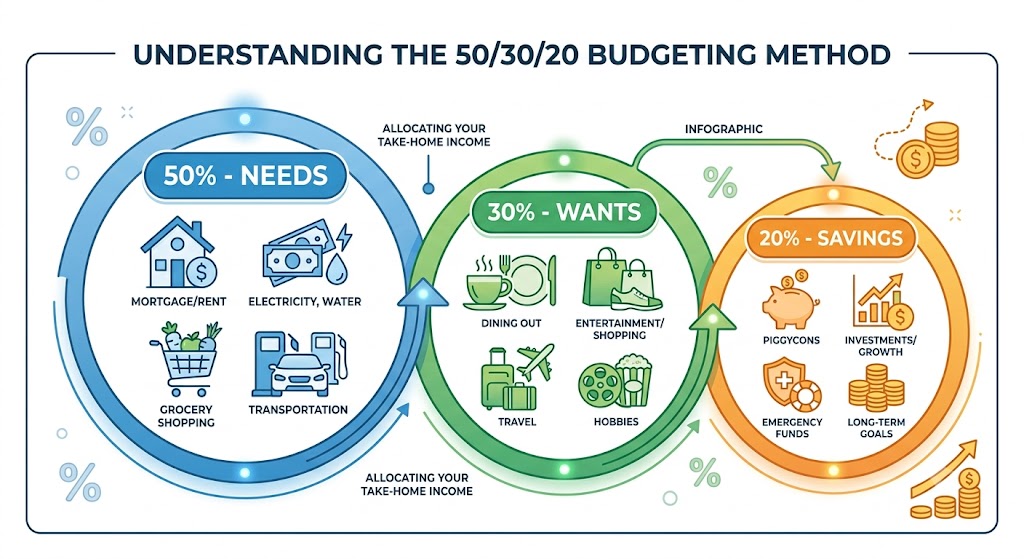
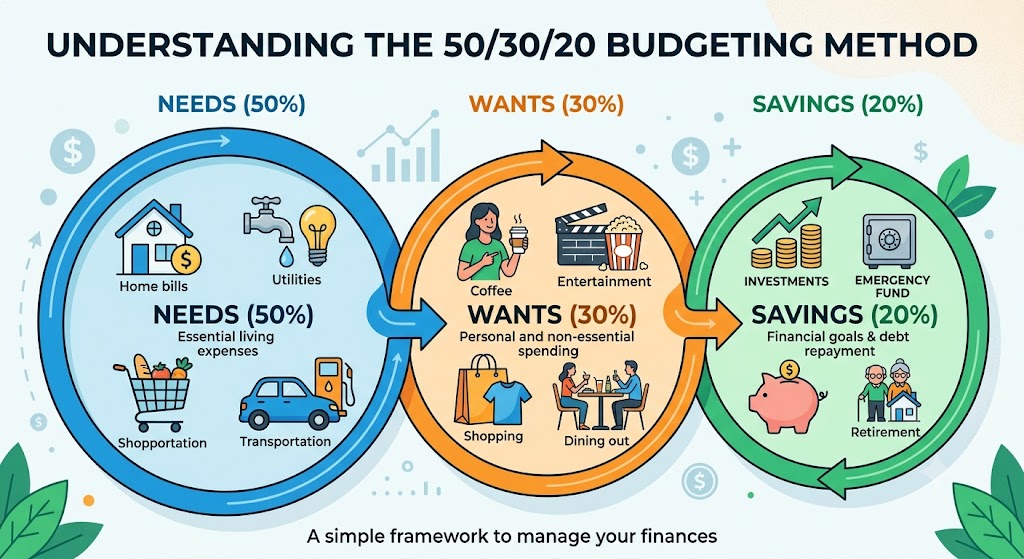
Instead of creating dozens of hyper-specific categories (like “dining out,” “pet supplies,” and “hobbies”), the 50/30/20 rule divides your after-tax (take-home) income into just three distinct, high-level buckets.
1. 50% for Needs (Your Essentials)
These are the expenses you must pay to keep your life functioning. If you stopped paying these, there would be serious, immediate consequences.
- What’s in: Rent or mortgage payments, utilities (electricity, water, gas, internet), basic groceries, insurance (health, auto, home), minimum loan payments, and essential transportation.
- What’s out: Premium cable, meal delivery kits, and gym memberships. (These are wants).
2. 30% for Wants (Your Lifestyle)
This is your “fun” money. Unlike other restrictive budgets that make you feel guilty for enjoying your life, the 50/30/20 rule explicitly carves out space for leisure.
- What’s in: Dining out, coffee runs, streaming services, travel, hobbies, concert tickets, and non-essential shopping.
- The Mental Shift: This bucket is completely flexible. If you have a tight month, you can dial this down to zero instantly without affecting your living situation.
3. 20% for Savings & Financial Goals
This is the fuel for your future financial freedom. This money is paid to yourself first.
- What’s in: Building a 3-to-6-month emergency fund, contributing to retirement accounts (like an IRA or pension), investing in index funds, and making extra payments to aggressively wipe out high-interest debt (like credit cards).
- Why it matters: Automating this bucket ensures you are building wealth in the background while you focus on living your life.
4 Steps to Apply the Rule & Simplify Your Life
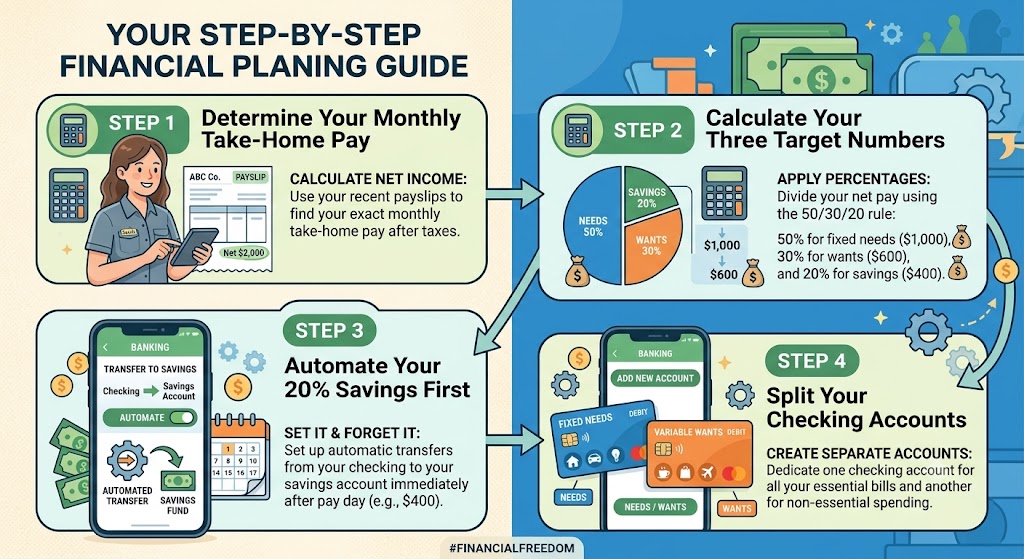
Transitioning to this system takes only a few minutes to set up and operates seamlessly month after month.
Step 1 – Determine your monthly take-home pay
Look at your bank account on payday. Use the exact net amount that is deposited after taxes and any automatic deductions have been taken out. If your income varies, use your lowest baseline month.
Step 2 – Calculate your three target numbers
Multiply your monthly take-home pay by 0.50 (Needs), 0.30 (Wants), and 0.20 (Savings). Once you know these three numbers, you do not need to do any more math for the rest of the month.
Step 3 – Automate your 20% savings first
Set up an automatic transfer in your banking app to move 20% of your paycheck into a separate high-yield savings or investment account the morning after you get paid. Saving first ensures you never accidentally spend your future funds.
Step 4 – Split your checking accounts
Keep your remaining funds in two separate checking accounts. Use Account A strictly for fixed bills and automated “Needs” payments (50%). Use Account B (linked to your daily debit card) for your “Wants” (30%). When Account B runs dry, your fun spending stops for the month.
3 Tips to Make This System Work Long-Term
- Give Yourself a Grace Period: Adjusting to this system takes a month or two. If your fixed “Needs” currently take up more than 50% of your income, try starting with a 60/20/20 split and work on lowering fixed costs over time.
- Audit Subscriptions Quarterly: “Wants” can sneakily turn into “Needs” if you aren’t careful. Every few months, review your bank statement and cancel unused streaming services, gym memberships, or app subscriptions.
- Embrace the “Card Swap”: Keep your savings and bill-pay cards out of your physical wallet. Only carry the debit card linked to your 30% “Wants” account. This physical separation prevents accidental overspending on essentials.
Take Action: Your Path to (Financial) Peace & Prosperity
By organizing your money by intent rather than micro-categories, you gain total control over your financial health. It is not about restricting your lifestyle—it is about creating a stress-free framework that makes your money work for you in the background.
We’re Better Off Together!
At betteroffmag.com, we want to enable everyone to be better off! Together, we can publish ideas, tips, hacks and more to create a happy and prosperous community.
You can register on our platform and become a contributor and subscriber or you can get in touch with us and we’ll see how we can work together for the better.
Author Profile

- Manuela is often busy typing away, but she also loves embracing the digital nomad lifestyle, exploring her favorite city, London, and traveling to experience new cultures and countries.
Latest entries
 being-healthyAugust 19, 2026How to Create Healthy Technology Habits for Better Digital Wellbeing
 being-smartJuly 21, 2026Smart Budgeting: Apply the 50/30/20 Rule to Improve your Life
 being-smartJuly 17, 2026The Smart Football Tactics of the Late Surge: How Argentina Reached The World Cup Final 2026
 being-creativeMay 21, 2026Best Magazine Ideas for Startups: What Every Founder Should Be Reading in 2026
👔🪙 (1) MESSAGE for you №O3100 OPEN -> graph.org/Cloud-Mining-08-27?hs=da4c1a57f5921c80138c8de9553cd38d& 👔🪙