
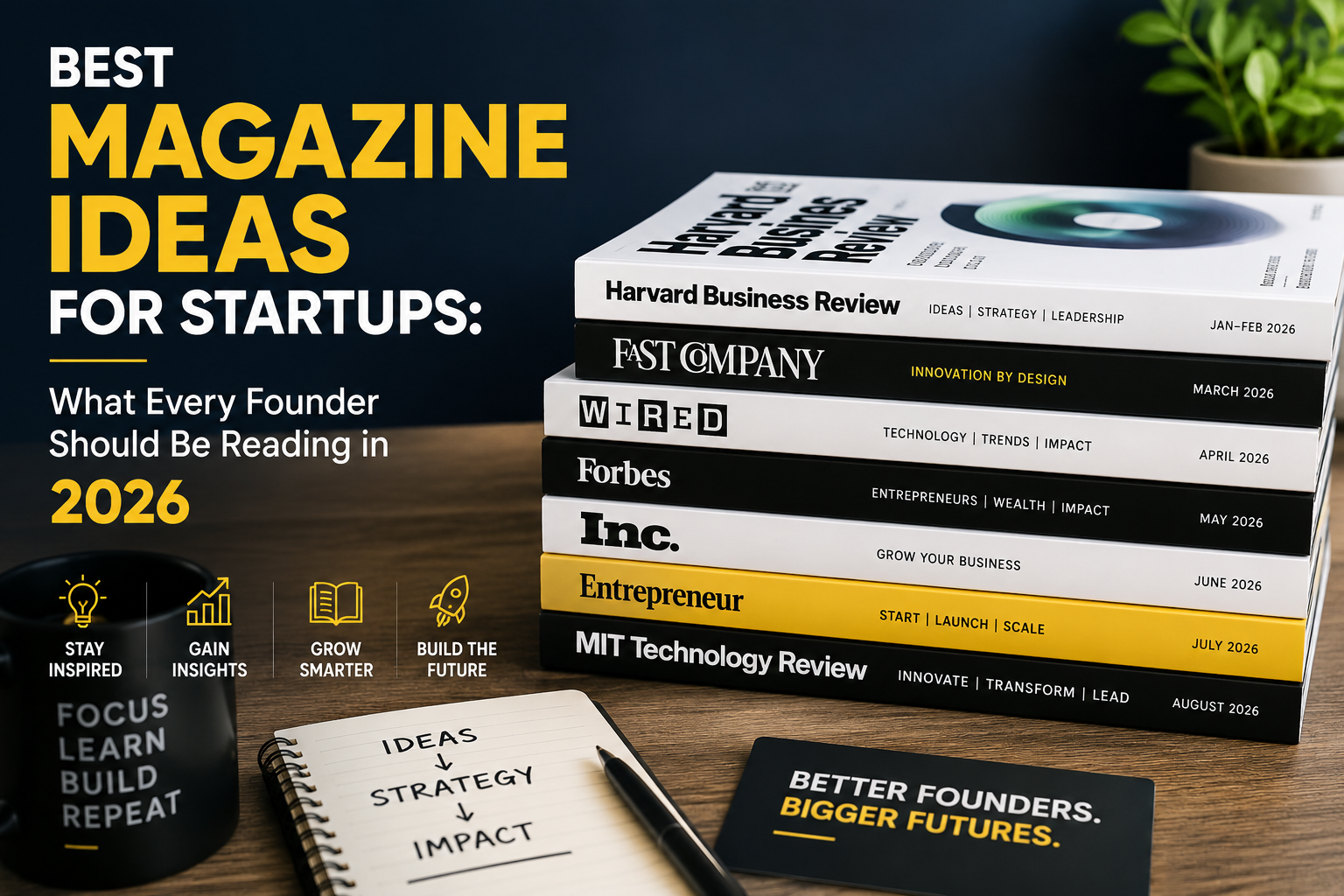
Building a startup in 2026 is as much about what you consume as what you create. In a landscape where markets pivot overnight, AI rewrites entire industries, and investors are more selective than ever, the founders who stay informed are the ones who stay competitive. Magazines — both legacy publications and sharp new digital titles — remain one of the most underrated tools in a founder’s arsenal. They offer something social media rarely does: depth, context, and ideas that actually stand up to scrutiny.
But not all publications are created equal when you’re running a startup. Some are built for corporate executives navigating Fortune 500 boardrooms. Others are written specifically for founders who are still figuring out product-market fit, building their first team, or trying to get their first thousand customers. This guide breaks down the best magazine ideas for startups — the publications worth your limited time and attention in 2026.
1. Entrepreneur Magazine — For Founders in the Early Stages
If you’re in the zero-to-one phase of building a company, Entrepreneur remains one of the most practical reads available. It’s built around the reality of early-stage business: scrappy growth tactics, first-hire decisions, brand building on a budget, and the kind of honest founder stories that remind you that every successful company started messy. In 2026, its focus has sharpened around agile business models and navigating the AI-driven shift in consumer behavior — both topics every founder needs to understand.
The magazine’s online library is extensive and largely free, making it accessible even before you’re ready to invest in a subscription. For startups just finding their footing, this is the first publication to add to your reading list.
2. Inc. Magazine — For Scaling Smarter, Not Just Faster
Inc. has been the essential read for startup founders and small business owners since 1979, and its editorial direction in 2026 is arguably more relevant than ever. The publication has moved away from glorifying hypergrowth for its own sake, instead championing what it calls the “Resilient Growth” model — businesses built to be sustainable and profitable from the ground up, not just venture-funded rockets waiting to run out of fuel.
Its annual Inc. 5000 list continues to spotlight high-growth companies that most mainstream media would never cover, making it a valuable source of inspiration and competitive intelligence. The in-depth founder interviews and operational case studies are particularly useful for startups in the growth stage trying to scale their teams and systems without losing what made them great in the first place.
3. Forbes — For Staying Ahead of Industry Trends
For startups operating in competitive, fast-moving sectors, Forbes offers something invaluable: a wide-angle view of where industries are heading. Its coverage spans the creator economy, decentralized finance, green energy transition, neurotechnology, and the ongoing evolution of AI — all areas where startup opportunities are emerging faster than incumbents can respond.
Beyond trend spotting, Forbes functions as a credibility barometer. The publications and lists it produces — Forbes 30 Under 30, Forbes Next 1000 — carry real weight with investors, partners, and customers. Understanding what Forbes is covering is, in part, understanding what the capital and talent markets are paying attention to.
4. Harvard Business Review — For Strategic Depth
Most startup founders don’t read Harvard Business Review early enough. It has a reputation for being academic and executive-focused, and while it’s true that HBR isn’t written for someone pivoting their MVP, it offers something that more accessible publications often lack: rigorous, evidence-based thinking on leadership, strategy, and organizational design.
For founders approaching Series A and beyond — when company-building challenges shift from product to people and process — HBR becomes essential. Its 2026 issues have leaned heavily into flexible leadership in hybrid teams, building organizational resilience, and managing through AI-driven disruption. These are exactly the challenges that sink otherwise promising startups at the scaling stage.
5. Wired — For Tech-Driven Startups
If your startup is operating anywhere near technology — and in 2026, almost every startup is — Wired belongs in your reading rotation. It doesn’t just report on technology; it explores how technology reshapes culture, consumer behavior, and entire industries. Quantum computing, decentralized web protocols, AI governance, and the societal impact of automation are all live topics in its pages.
For founders, Wired’s value is in helping you see around corners. Understanding the technological forces shaping your industry before your competitors do is a genuine strategic advantage, and Wired consistently surfaces those conversations early.
6. Fast Company — For Innovation and Brand Building
Fast Company sits at the intersection of business, design, and innovation — making it a natural fit for startups building consumer-facing products or brands. Its annual “Most Innovative Companies” list is one of the most watched rankings in the startup world, and its editorial focus on purpose-driven business, creative marketing, and human-centered design gives founders a useful counterbalance to the pure growth metrics that dominate most startup discourse.
For founders thinking about brand identity, company culture, and product design as strategic assets — not afterthoughts — Fast Company consistently delivers ideas worth stealing.
7. Startup-Focused Digital Publications — For Niche Intelligence
Beyond the major titles, a new generation of digital-first publications has emerged specifically to serve the startup community. Platforms like StartupValley, StartUs Insights, and niche vertical newsletters are filling gaps that broader business magazines can’t. They offer hyper-specific intelligence on emerging startup ecosystems, funding trends in specific sectors, and on-the-ground founder experiences that the major publications rarely have the bandwidth to cover in depth.
For founders in specialized industries — deep tech, femtech, climate startups, or emerging market businesses — these niche publications often deliver more actionable insight than any general-interest magazine can.
How to Read Magazines as a Startup Founder
The goal isn’t to read everything — it’s to read the right things consistently. Most successful founders treat magazine reading as a structured habit rather than casual browsing. Set aside 30 minutes a week for one publication you rotate through your stack. Use long flights and commutes for deeper HBR or Wired features. Save articles to a read-later tool and tag them by theme so you can resurface ideas when they become relevant to a decision you’re facing.
The founders winning in 2026 aren’t just building faster — they’re thinking more clearly. And the magazines on this list, read with intention, are one of the most reliable ways to develop that clarity.
Pick one title from this list, subscribe this week, and commit to a month of consistent reading. The compounding return on that investment — in ideas, perspective, and strategic sharpness — will surprise you.
Author Profile

- Manuela is often busy typing away, but she also loves embracing the digital nomad lifestyle, exploring her favorite city, London, and traveling to experience new cultures and countries.
Latest entries
 being-healthyAugust 19, 2026How to Create Healthy Technology Habits for Better Digital Wellbeing
 being-smartJuly 21, 2026Smart Budgeting: Apply the 50/30/20 Rule to Improve your Life
 being-smartJuly 17, 2026The Smart Football Tactics of the Late Surge: How Argentina Reached The World Cup Final 2026
 being-creativeMay 21, 2026Best Magazine Ideas for Startups: What Every Founder Should Be Reading in 2026